Lost Art Files – Himachal Pradesh: Durga, Raktabij & Kali
लुप्त कला संचिका: उन्नीसवीं सदी चम्बा की पहाड़ी लघु चित्रकला – दुर्गा, रक्तबीज एवं काली
Exquisite 19th-century watercolor folios from Chamba ateliers, capturing the ferocious aesthetic of Bhayanaka rasa, the Devi Mahatmya narrative, and the dynamic battle against demonic forces.
In this edition of Lost Art Files we bring to you some exquisite watercolor art pieces from early 19th Century Chamba, Himachal Pradesh. These high energy compositions from the Dev Bhoomi wonderfully capture the spiritual and folklore theme that is so central to the region.
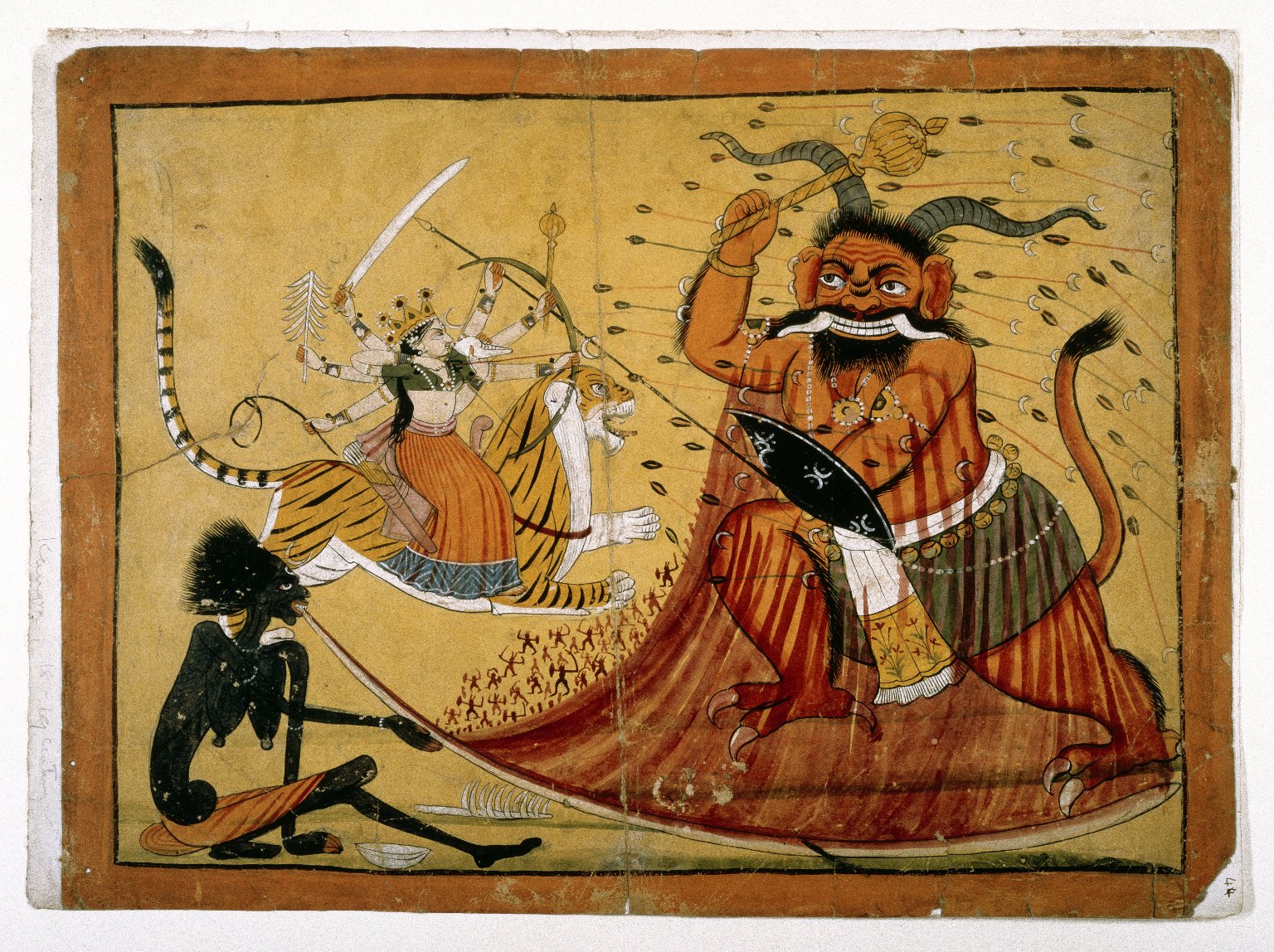
Durga Slaying the Buffalo Demon, Raktabij, and Kali Lapping up the Demon's Blood
Page from a Markandeya Purana Series
The Folklore
The combined episodes of Durga's attack on the demon and Kali's lapping up his blood are here presented in one highly energized composition.
A great orange-red monster with a human body, bird's claws, buffalo horns, white tusks, and a ferocious expression, is represented at the right. The multi-armed crowned goddess Durga, astride her tiger vehicle, pierces the demon and attacks with her numerous weapons, while the black goddess Kali extends her long tongue to lap up the blood shed by the demon before it touches the ground and coagulates into new asuras (demons).
Some of the blood is transformed into numerous tiny Raktabij demons, emerging from the bloodbath who continue the battle. The violent scenes of bloody battle express the dynamic energy of the Goddess. These two episodes are related in the Devi Mahatmya text of the Markandeya Purana, in which the Goddess destroys various forms of demons, but multiple episodes incorporated in the same miniature is unusual.
The Bhayanaka rasa, or the terrible sentiment, is predominant in this scene. Depiction of Devi in her frightening form of Kali, engaged in devouring up the blood drops and tiny demons emerging from them, successfully conveys the sentiment here.
Durga Slaying the Buffalo Demon
Folio from Devi Mahatmya (Glory of the Goddess)
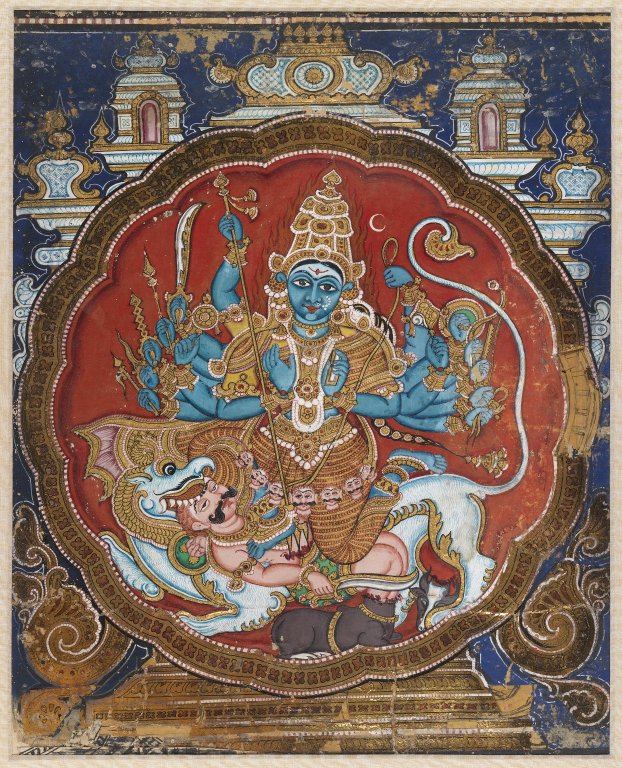
The Art
These depictions from the hills are attributed to Chamba, which was noted for a predominantly red and yellow palette and produced many illustrated Devi Mahatmya manuscripts.
One may compare these stylistic characteristics with the more refined versions of this subject in the Devi Mahatmya in Guler, c. 1740-1781 (Aijazuddin 1977: 48). Rather large and very coarse miniature painting, of Durga slaying the demon Mahisa (the asura Mahisa) with a flock of arrows, an illustration from the Markandeya Purana, a collection of mythological legends.
The asura, a huge orange red monster with a human body, birds claws, an animal's white tusks, and a ferocious expression, is represented as rising from the purple emanation coming from the mouth of a demon.
This demon, a gaunt female nude save for a dhoti, and with straight hair flying out behind, sits in one corner exhaling this emanation. The asura has a short dhoti and a white sash (kamarband) with yellow flower ends. Bells hang from the sides of the scarf around the waist. He also has armlets (bhuja-band), necklaces (mala) and bracelets (kankana).
Close to the edge of the emanation are quantities of tiny asuras, colored the same as the emanation. The devi, astride a tiger, has eight arms. Two are used in shooting the crescent pointed arrow at the asura. The others hold a mace, a spear (sakti), a feather, a sword, a noose (pasa) and a conch (sankha). She has a full red skirt (ghagara) with a blue edge, a purple sash, a short green coli, a pointed crown (mukuta) and a quiver of arrows. She wears necklaces, earrings, armlets and bracelets and has her finger and toe nails dyed henna (mihamda).
The background is yellow, save for a few streaks of green to represent the ground. On this are a white bowl and a white feather like the one the Devi is holding. The painting has a red border and is mounted on a slightly larger sheet of paper.
Iconography, Rasa & the Pahari Imagination
How Himalayan court workshops translated classical Sanskrit canonical texts into visceral visual narratives.
Bhayanaka Rasa (भयानक रस)
Bhayanaka RasaIn classical Indian aesthetic theory (Natya Shastra), Bhayanaka represents the sentiment of terror, dread, and awe. Rather than pure horror, the Pahari masters channeled this aesthetic into religious veneration—illustrating the destructive potency required to eliminate cosmic malevolence.
Raktabija's Blood Cloning Myth (रक्तबीज)
RaktabījaAccording to the Devi Mahatmya, every droplet of Raktabija's blood that struck the earth spontaneously replicated another fully armed warrior demon. Kali's wide, outstretched tongue intercepts the blood mid-air, preventing subterranean multiplication.
Chamba vs. Guler Atelier Styles
Pahari KalamWhile Guler court workshops favored soft pastel tones, delicate facial modelling, and courtly restraint (c. 1740–1781), Chamba artists cultivated an exuberant, raw vigor—employing high-contrast cadmium yellows, vermilion borders, and fierce geometric motion.
Sacred Armaments & Hill Adornments
Ayudha & AbharanaThe Devi's weapons include the crescent arrow, sakti (spear), pasa (noose), and sankha (conch). Her attire combines divine insignia with regional Pahari court fashion: the billowing ghagara skirt, green coli blouse, and henna-dyed nails (mihamda).
References & Archival Sources
Resident Pahari Cultural Desk (2024). "Lost Art Files – Himachal Pradesh: Durga, Raktabij & Kali — Exquisite 19th-century watercolor folios from Chamba ateliers, capturing the ferocious aesthetic of Bhayanaka rasa, the Devi Mahatmya narrative, and the dynamic battle against demonic forces." Resident Pahari. Period: Circa 1800–1825 CE. Canonical URL: https://residentpahari.com/post/lost-art-files-hp-i/
The Himachal Weekly, Directly in Your Inbox.
Join a growing community of 4,000+ across Himachal. Get our weekly synthesis of news across all districts and in-depth analysis.